Quick Answer
A medical appraisal is an annual review of your work as a doctor. It is a GMC requirement and helps show that you are keeping your skills, knowledge and professional standards up to date.
Keeping on top of your appraisals matters because they build the evidence needed for your GMC revalidation every 5 years.
If you do not have the usual appraisal and revalidation evidence, the GMC may require you to complete a revalidation assessment instead.
The assessment currently involves:
120 multiple-choice questions
2 hours
Most doctors would understandably rather avoid this — so keeping your appraisal evidence up to date is the much simpler route.
Why This Matters
Appraisal matters because it:
Meets the GMC requirement for an annual appraisal
Builds the evidence needed for revalidation every 5 years
Shows your skills and knowledge are up to date
Gives you a chance to review the year, including what you have learned and experienced
Provides space to discuss complaints, significant events, health or other professional issues
Helps you set clear goals for the year ahead
Think of it as your annual professional check-in — not just a collection of certificates.
What the Guidance Actually Requires
The GMC expects doctors to take part in appraisal every year.
Your appraisal should:
Cover your whole scope of practice — every role you do that requires your GMC registration
Be based on the principles of Good medical practice
Include reflection on relevant supporting information
Help identify learning needs and improvements for the year ahead
Contribute to the evidence used for revalidation
Two useful rules
Appraisal is annual. If this is your first appraisal, this will usually mean around 12 months after gaining full GMC registration.
Include all of your medical work. If you use your GMC registration for a role, it should normally be included in your appraisal.
How It Works in Practice
The appraisal process is fairly straightforward:
Arrange your appraisal
Build your portfolio using appraisal software such as FourteenFish, L2P or Reval360
Collect your evidence — including around 50 hours of CPD and appropriate quality improvement activity
Submit your portfolio ideally at least 2–3 days before the appraisal
Your appraiser reviews it
Have your appraisal meeting and discuss the year
Agree your PDP for the year ahead
Your appraiser writes the report
Both sides sign it off
Repeat each year throughout your revalidation cycle
See It Done Instead
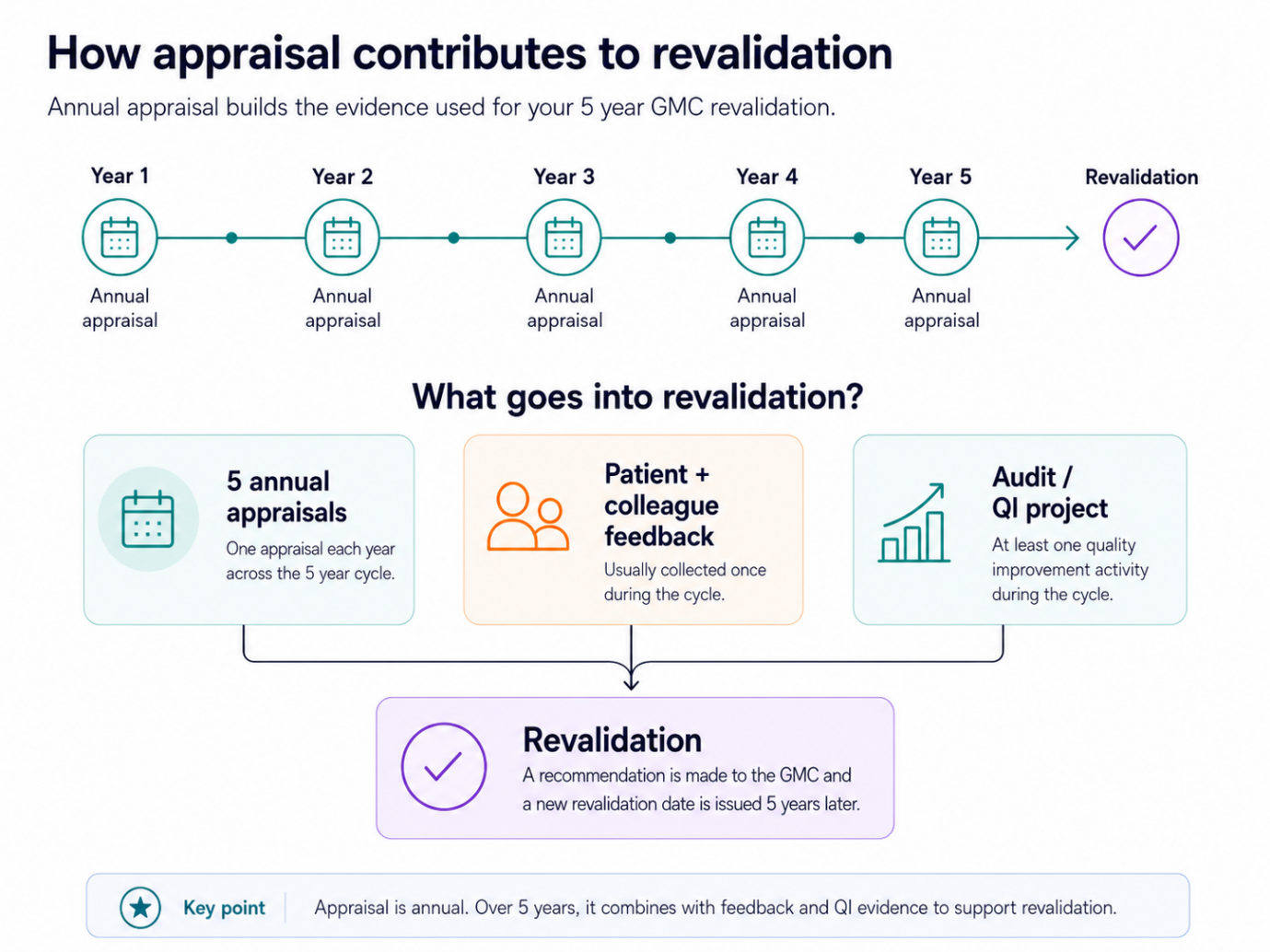
How appraisal contributes to revalidation
Your annual appraisals build the evidence used for your GMC revalidation.
5 annual appraisals – one appraisal for each year of the revalidation cycle
Patient + colleague feedback – usually completed at least once during the 5-year cycle
Audit / quality improvement – evidence that you have reviewed and improved your practice
At revalidation, this evidence is considered alongside your appraisal history before a revalidation recommendation is made to the GMC.
Revalidated → your next revalidation date is normally 5 years later.
What good looks like
A well-prepared appraisal usually has:
Appraisal completed on time – ideally within your appraisal window
Good reflection throughout – on your scope of work, achievements, challenges and learning
A varied CPD portfolio – webinars, podcasts, courses, conferences, teaching, case reflections and procedure logs rather than dozens of similar online modules
Mandatory training up to date – including BLS / ALS where relevant
Clear quality improvement evidence – an audit or QI activity written up properly, showing what you did and what changed
Structured case discussions – if using CBDs, use a proforma and document discussion with an appropriate senior
CV and references included where available
An open appraisal meeting – be prepared to discuss and reflect on each section of your portfolio
The aim is not to upload as much evidence as possible. It is to show a balanced picture of your work, learning and development over the year.
Common mistakes
A few things commonly cause problems:
Leaving it too late – trying to build the whole portfolio just before the appraisal
Only including your main job – appraisal should cover your whole scope of practice
Confusing appraisal with revalidation – appraisal happens every year; revalidation is usually every 5 years
Poorly evidenced CPD – listing learning without enough detail, evidence or reflection
Best approach: keep your portfolio updated throughout the year rather than trying to recreate everything at the end.
Myth trap
“I don’t need an appraisal this year because…”
In most cases, you probably do.
The GMC expectation is that doctors take part in appraisal every year. This still applies if:
You have worked very little during the year
You are between jobs
You are planning to return to training
You think you already have enough appraisals for revalidation
You may occasionally revalidate with fewer than five appraisals, but gaps will usually need to be explained to your Responsible Officer or Suitable Person.
Simple rule: unless you have a clear reason not to, plan to complete an appraisal every year.
Sources / last reviewed
GMC – Revalidation assessment for doctors without a Responsible Officer or Suitable Person
GMC – Additional requirements for doctors without a connection
Last reviewed: August 2026