Quick Answer
Patient and colleague feedback is formal feedback about how other people experience you and your professional practice. It can highlight what you are doing well, identify areas for improvement, and reveal recurring themes that are useful to reflect on as part of your appraisal.
You would normally be expected to complete formal patient feedback and formal colleague feedback at least once during each revalidation cycle, usually every five years. This is not something that needs to be repeated every year. The feedback should, as far as possible, reflect your whole scope of practice, and you should review the results, reflect on any themes, and discuss them during your appraisal.
For colleague feedback, try to include people from a range of professional roles and levels of seniority. Depending on your work, this might include nurses, physiotherapists, occupational therapists, administrative staff, senior doctors, doctors of a similar grade, junior colleagues and other members of the multidisciplinary team.
For patient feedback, a recognised questionnaire or another appropriate formal feedback method can be used. You should also bring relevant informal patient feedback, compliments or recurring themes to your annual appraisal where these provide useful evidence or learning.
Why This Matters
Patient and colleague feedback forms an important part of your revalidation cycle and provides evidence about how others experience your professional practice.
A commonly used benchmark is 34 completed patient questionnaires and 15 completed colleague questionnaires, although the exact requirements may vary depending on the feedback tool and your organisation.
Formal patient and colleague feedback is an important revalidation requirement. If it has not been completed appropriately during the revalidation cycle, this can delay or prevent a positive revalidation recommendation.
Feedback is also valuable beyond the formal requirement. It helps you review your practice, identify strengths and areas for development, recognise recurring themes, and build greater self-awareness.
What Does the Guidance Actually Require?
The GMC requires you to collect, reflect on and discuss formal patient feedback and formal colleague feedback at least once during each revalidation cycle. You do not need to complete a formal feedback exercise every year.
Your colleague feedback should:
Include colleagues from across your scope of practice.
Include people from a range of different professional roles, including people who are not doctors.
Be obtained from colleagues chosen impartially rather than simply selecting people you know will give positive feedback.
Ideally use a validated questionnaire administered independently, so that the process remains objective and confidential.
Be reviewed and reflected on, including considering what it tells you about your strengths and any areas for development.
Your patient feedback should:
Include a formal, solicited feedback exercise at least once during the revalidation cycle.
Be appropriate to your patients and the type of work you undertake.
Be sufficiently representative to allow meaningful reflection on your practice.
Be processed independently where you are arranging the exercise yourself, rather than you personally collecting and collating your own responses.
Be reflected upon and discussed at appraisal, including any learning or changes you intend to make as a result.
The GMC does not currently specify a fixed minimum number of patient or colleague questionnaires that every doctor must obtain. The commonly quoted figures of 34 patient responses and 15 colleague responses come from research showing that these numbers provided acceptable reliability for the GMC questionnaires. In practice, the questionnaire or feedback provider will usually advise how many responses are required.
You should also consider informal or unsolicited patient feedback at each annual appraisal where it is relevant. This might include thank-you cards, comments, emails or other feedback received during your work.
If you do not see patients, the GMC allows feedback to come from other people to whom you provide medical services, such as students, clients or people who rely on your professional opinion. Where meaningful patient or equivalent feedback genuinely cannot be obtained, this should be discussed and agreed with your Responsible Officer or Suitable Person.
Patient Feedback
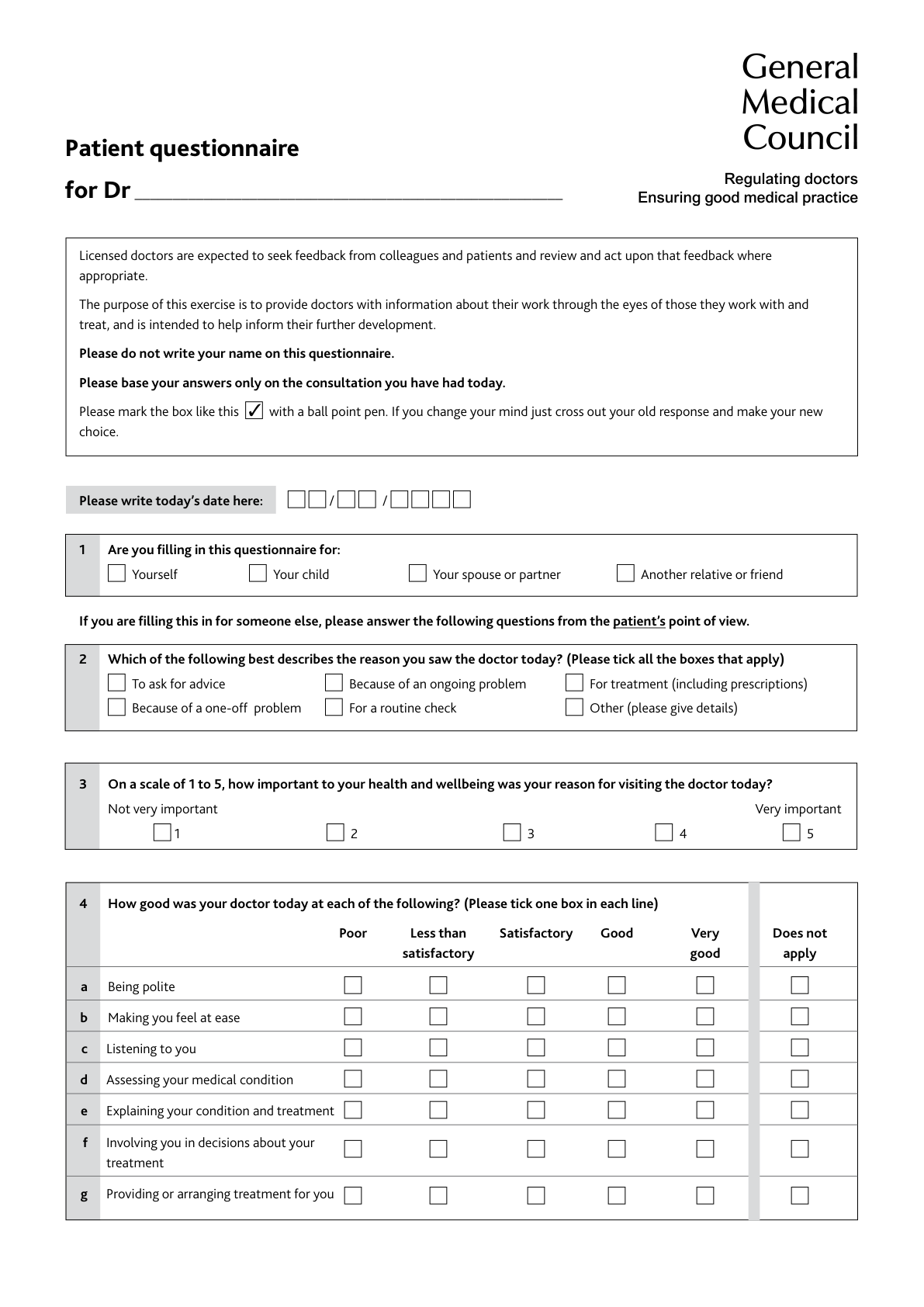
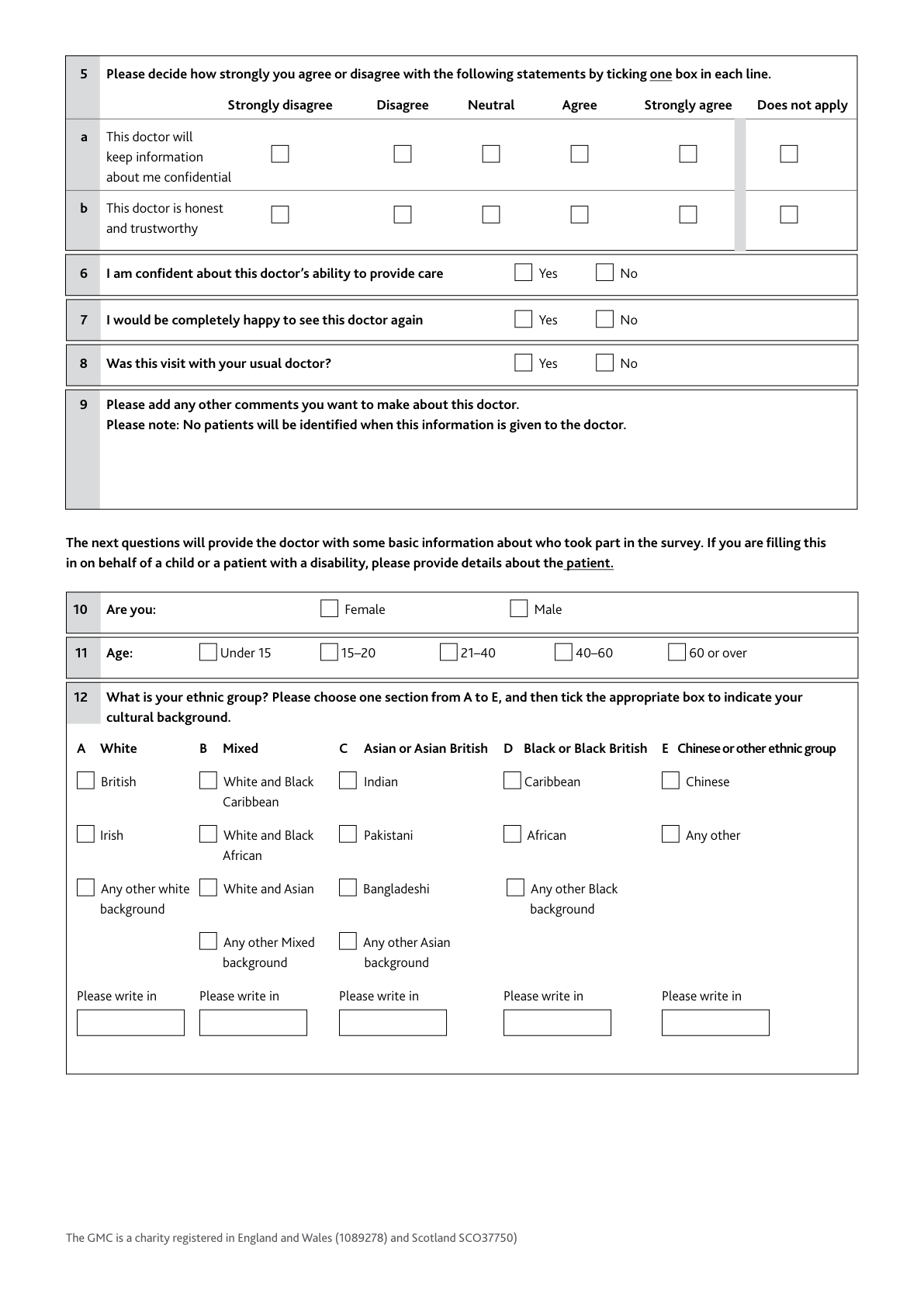
The GMC provides a patient feedback questionnaire that can be printed and given directly to patients. There are also a number of software-based feedback systems available. Although the format varies, most use broadly similar questions and assess similar aspects of professional practice.
A few points are worth noting:
Feedback is anonymous. Patients are specifically asked not to put their name on the questionnaire.
Feedback relates to a specific consultation. Patients are asked to base their answers on the consultation they have had that day, rather than giving a general impression of the doctor.
The questionnaire looks at several aspects of your practice, including politeness, making patients feel at ease, listening, clinical assessment, explaining conditions and treatment, involving patients in decisions, and arranging appropriate treatment.
There is space for free-text comments, which can be particularly useful when reflecting on themes, strengths or areas for development.
Once the exercise is complete, the feedback should be reviewed and reflected on as a whole, rather than focusing on individual responses in isolation.
Software-based systems can be especially useful because they will often collate and summarise the responses, for example by showing average scores, distributions and recurring themes. This can make it easier to identify patterns in your feedback and produce a meaningful reflection for your appraisal.
The GMC paper-based patient feedback form is shown below as an example of the type of questionnaire that can be used.
Colleague Feedback
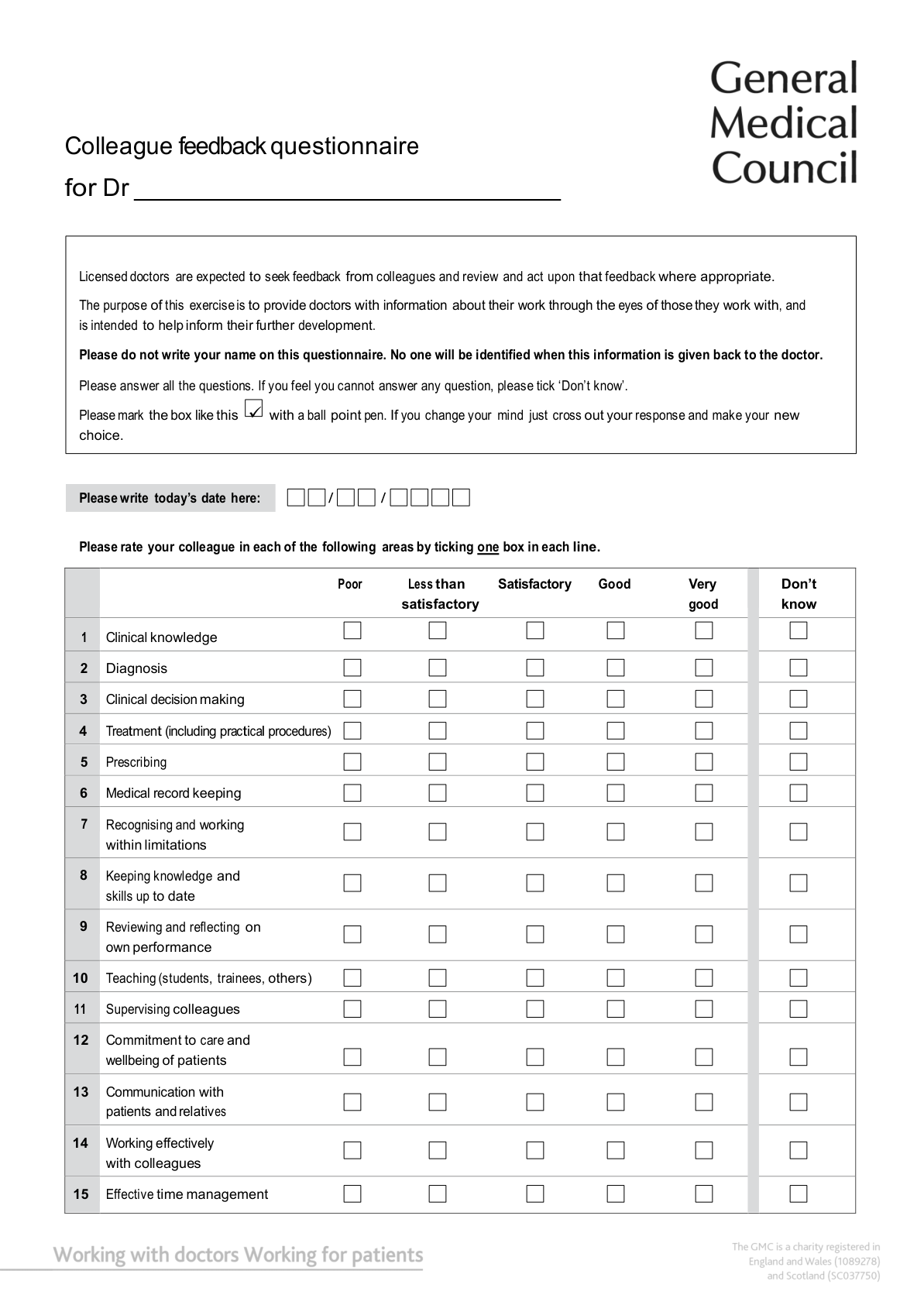
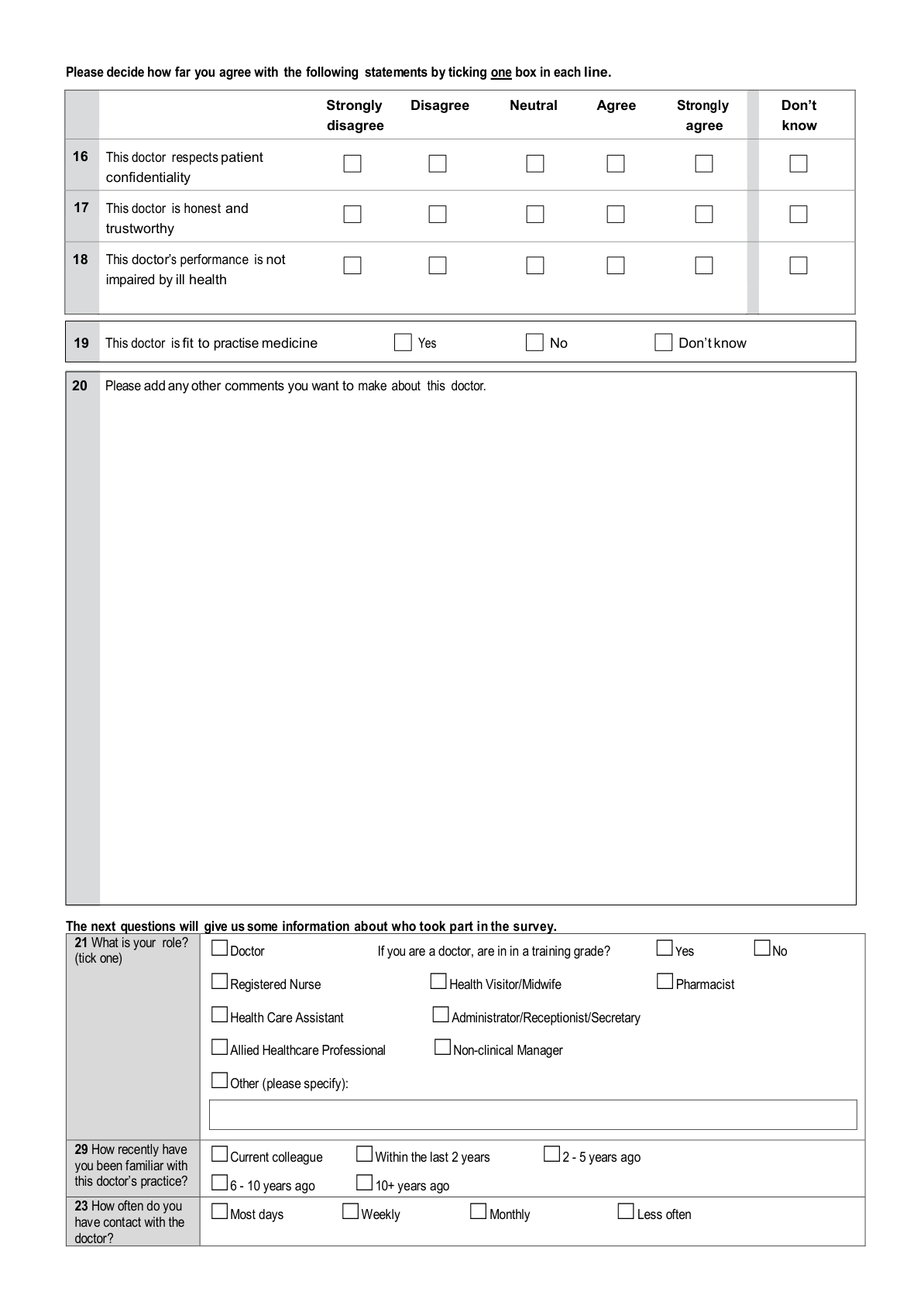
The GMC provides a colleague feedback questionnaire that can be printed and given to colleagues. There are also a number of software-based feedback systems available. Although the exact format varies, most are built around similar themes and assess broadly similar aspects of professional practice.
A few points are worth noting:
Feedback is anonymous. Colleagues are specifically asked not to put their name on the questionnaire, and the GMC states that individual respondents will not be identified when the feedback is returned to the doctor.
The questionnaire looks at a broad range of clinical and professional skills, including clinical knowledge, diagnosis, decision-making, treatment, prescribing, record keeping, recognising limitations, keeping skills up to date and reflecting on performance.
It also covers teaching, supervision, communication, teamwork and time management, as well as commitment to patient care and wellbeing.
Colleagues are asked about professionalism and probity, including confidentiality, honesty and trustworthiness, and whether they consider the doctor fit to practise.
There is space for free-text comments, which can be particularly helpful when identifying strengths, recurring themes or areas for development.
The questionnaire records the professional role of the person giving feedback and asks how recently and how frequently they have worked with the doctor. This helps provide context for the responses and demonstrates that feedback has been obtained from colleagues who know the doctor's practice.
Once collected, the feedback should be reviewed and reflected on as a whole, rather than concentrating on individual scores or comments.
Software-based systems can be particularly helpful because they often collate and tabulate the responses, allowing you to see average scores, the range of responses and any recurring themes. This can make it easier to understand how colleagues experience your practice and provide useful material for reflection at appraisal.
The GMC paper-based colleague feedback form is shown below as an example of the type of questionnaire that can be used.
How to Collect Feedback Properly
For colleague feedback, software-based systems are usually the easiest and most commonly used option. You enter the details of the colleagues you want to invite, and the system sends out the questionnaires, collects the responses anonymously and usually produces a summary report for you to review. This also makes it easier to demonstrate that the process has been handled independently.
For patient feedback, both electronic and paper-based systems are still commonly used. Online questionnaires can be convenient, but paper forms remain useful, particularly where some patients may be less comfortable using smartphones, QR codes or online forms.
If you are using paper patient questionnaires, it is better not to hand them out and collect them yourself. A receptionist, nurse, healthcare assistant or another member of staff can distribute the forms and collect them back in, so that the patient's response remains anonymous and they do not feel under pressure to give favourable feedback.
Whichever method you use, the key principles are that the feedback should be anonymous, collected in a reasonably independent way, and representative of the people you actually work with or care for. Once enough responses have been collected, the results should be reviewed as a whole and reflected on before or during your appraisal.
How to Reflect on Feedback
The reflection does not need to be complicated. The important thing is to show that you have looked at the feedback as a whole, considered the themes, and thought about whether anything should change as a result.
A useful reflection would usually include:
What went well – for example, consistently strong feedback on communication, professionalism, teamwork or clinical care.
Any recurring themes – particularly comments or scores that appear more than once.
Anything unexpected – positive or negative feedback that surprised you.
Areas for improvement – even where the overall feedback is very good, there may still be one or two areas you could develop.
What you will do differently – this might be a specific change in practice, further learning, or simply maintaining an approach that patients and colleagues clearly value.
For example:
“Overall, the feedback was very positive, particularly around communication, professionalism and approachability. I was pleased that both patients and colleagues consistently felt listened to and treated with respect. One recurring theme was that explanations could occasionally be more concise, particularly in busy clinical settings. I will be more mindful of this and aim to check understanding more routinely at the end of consultations.”
A short but thoughtful reflection like this is usually much more useful than simply writing “feedback was positive, no concerns.”
What Good Looks Like
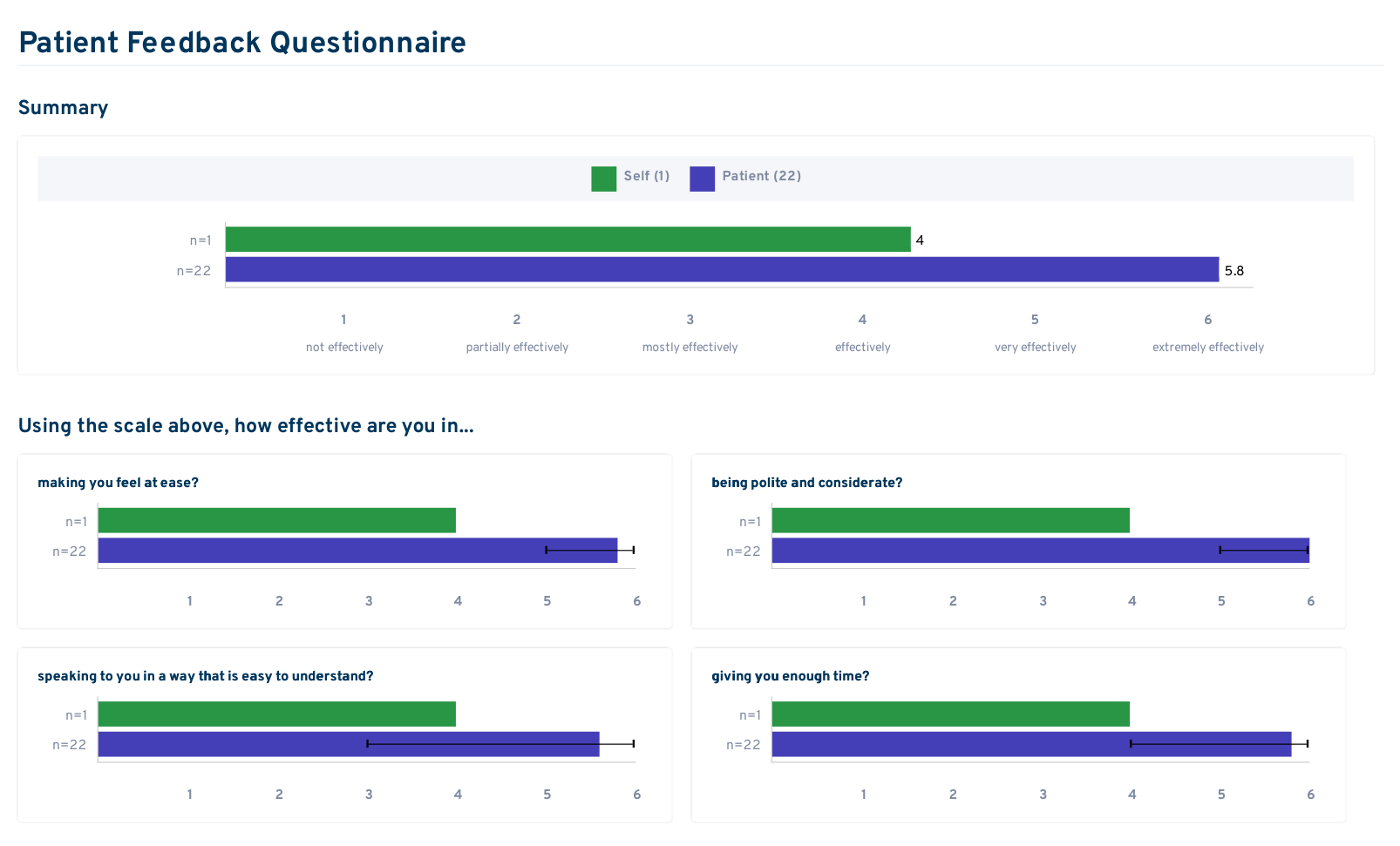
Good feedback does not mean every score has to be perfect. What you are looking for is a clear, consistent picture of your practice, supported by both the scores and the written comments.
In the example patient report:
22 patients completed feedback.
The overall patient score was 5.8/6.
22 out of 22 patients said they would recommend the doctor to friends and family.
Free-text comments repeatedly described the doctor as professional, reassuring, attentive, thorough and easy to understand. Patients also commented that they felt listened to, safe and involved in their care.
Example anonymised patient feedback summary:
Example patient feedback report - cropped and anonymised.
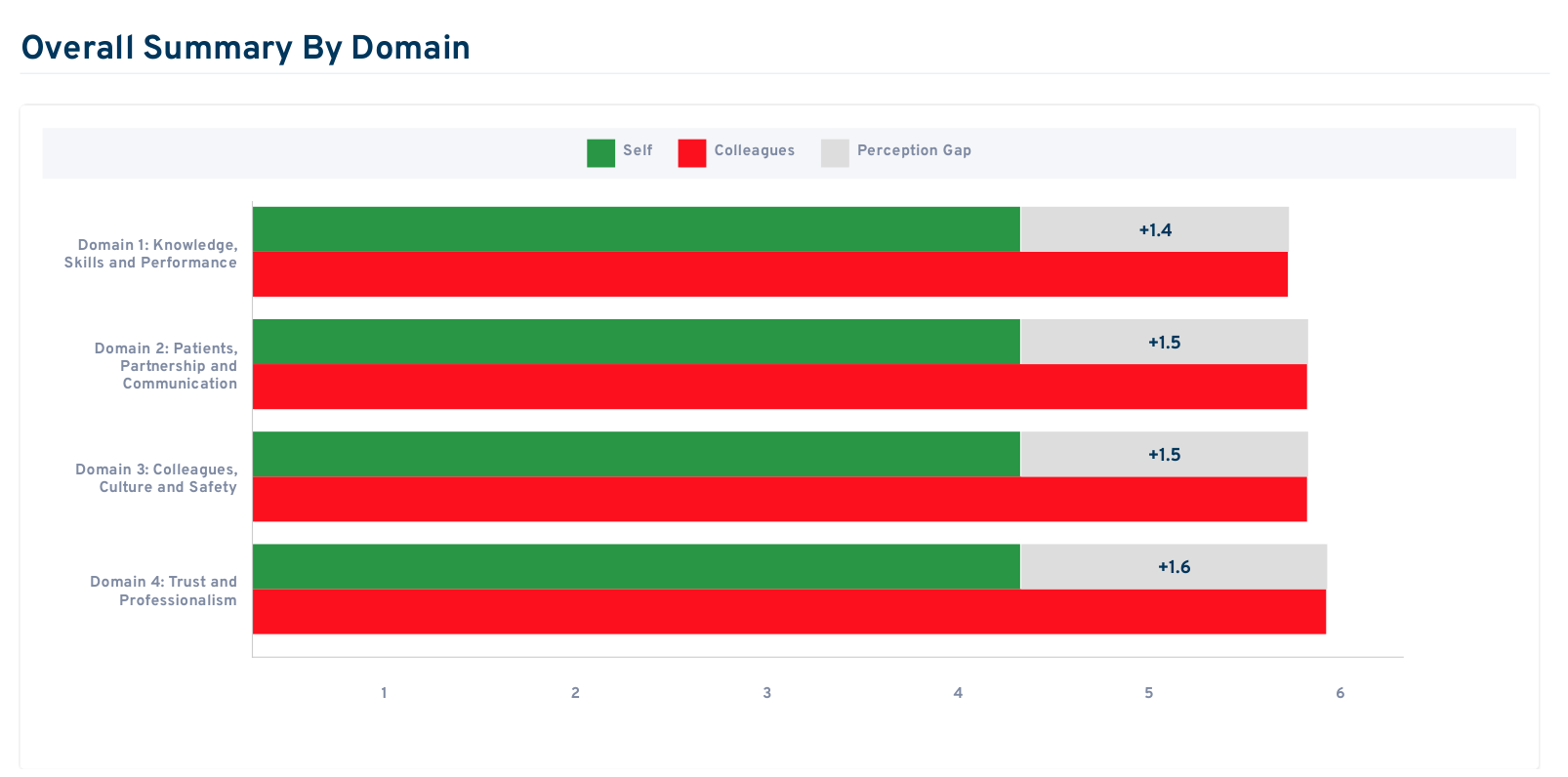
The colleague report shows the same kind of pattern. Feedback came from both peers and junior/support colleagues, with strong ratings across clinical knowledge, communication, teamwork, leadership and professionalism.
Example anonymised colleague feedback summary:
Example colleague feedback report - cropped and anonymised.
You are looking for three things:
Consistency — are the scores generally strong across the different areas?
Themes — do several people say similar things about your strengths?
Learning — is there anything useful you can take forward?
Constructive comments are not a bad thing. In this example, colleagues suggested greater involvement in audit, QI, governance and leadership, alongside some improvement in documentation and team communication.
That is actually useful feedback. It gives you something specific to reflect on and, if appropriate, something you can turn into CPD or a PDP objective.
Good feedback is therefore not “everything was excellent”. Good feedback is representative, consistent, reflective and gives you something useful to learn from.
Common Mistakes
The most common mistake is simply not collecting enough feedback. As a practical benchmark, aim for around 15 colleague responses and 34 patient responses. These are not fixed GMC minimums, but they are widely used because GMC research found that these numbers gave acceptable reliability for its questionnaires. Your own feedback provider may set a different target.
Another common mistake is uploading the feedback report without actually reflecting on it. Your appraisal should include a short reflection on the main themes, what went well, anything that surprised you, and whether there is anything you want to change or develop. The GMC specifically expects you to reflect on colleague feedback and consider how your own assessment compares with the views of colleagues.
For colleague feedback, avoid selecting only close friends or people you know will give you a good score. The group should be drawn impartially from across your scope of practice and include colleagues from different professional roles.
Myth Trap
“I need to do patient and colleague feedback every year.” You don't. Formal patient and colleague feedback is normally required at least once during each revalidation cycle, rather than annually.
“My feedback was all positive, so I don't need to reflect on it.” You still need to reflect. Positive feedback can help identify strengths worth maintaining, and comparing your own view of your practice with how others see you can itself provide useful learning.
“I don't see patients, so I can just leave patient feedback out.” Not necessarily. If you do not have patients, the GMC expects you to consider feedback from other people to whom you provide medical services. If meaningful feedback genuinely cannot be obtained, this should be agreed with your Responsible Officer or Suitable Person.
Sources / Last Reviewed
Sources: GMC Guidance on Supporting Information for Revalidation – Patient Feedback; GMC Guidance on Supporting Information for Revalidation – Colleague Feedback; GMC Multi-source Feedback Study.
Last reviewed: August 2026.