Quick Answer
A Personal Development Plan (PDP) is a short set of development goals that you agree as part of your annual medical appraisal. It records what you want or need to develop over the coming appraisal year and how you plan to achieve it.
What Is a PDP?
Most doctors will agree around 3–4 PDP objectives. These should be relevant to what you’re doing clinically for the year ahead.
A good PDP should be specific and achievable, with a clear idea of what you intend to do and how you will know when the objective has been completed.
At your next appraisal, your previous PDP is reviewed. And you will need to account for how the PDP has been achieved, not achieved no longer relevant etc.
It is not an expectation that all goals are achieved but there should be progress towards some of the goals.
What Should Be in Your PDP?
The exact format of a PDP varies slightly between appraisal platforms, but most will ask for the same core information:
Learning / Development Need
Agreed Actions / Goals
How you will demonstrate the need has been addressed
Achieve Date
The best PDP goals are linked to something you genuinely want or need to develop over the coming year. They should reflect your clinical work, career plans or professional interests rather than simply being added as a tick-box exercise.
For example, you could set a broad objective such as improving your leadership skills and complete some online management or leadership modules. This is acceptable, but it is fairly general and does not clearly define what you intend to achieve.
A stronger PDP goal is more specific and measurable. For example, if you are planning to sit the MSRA, you might aim to review the examination specification and complete at least 500 practice questions before the examination.
Example PDP Goal
| Learning / Development Need | Agreed Actions / Goals | How will you demonstrate your need has been addressed? | Achieve Date |
|---|---|---|---|
| Maintain and broaden current dermatology knowledge through external educational activity and exposure to developments in clinical practice and research. | Identify and attend at least one relevant dermatology conference or major educational meeting during the coming appraisal year. | Provide evidence of attendance and record CPD/reflection outlining the key learning points and any resulting impact on dermatology practice. | August 2027 |
A useful rule is to make each PDP objective clear enough that, at your next appraisal, you can easily explain what you planned to do, what you actually did and what you learned from it.
How Many PDP Objectives Do You Need?
Most doctors will agree around 3–4 PDP objectives for the year ahead.
As a general guide, aim for at least 3 goals, but usually no more than 5–6. It is better to have a small number of meaningful, achievable objectives than a long list of goals that are unlikely to be completed.
What Makes a Good PDP Objective?
A good PDP objective should:
Be relevant to what you want to achieve over the coming year.
Link to your current role, future career plans or an identified learning need.
Be specific enough that it is clear what you are actually planning to do.
Be realistic and achievable within the appraisal year.
Be evidencable, for example through certificates, courses, exams, reflective notes, feedback, projects or documented activity.
Show tangible progress in your professional development, rather than simply recording routine work.
Have a clear outcome, so that at your next appraisal you can explain what you did and what changed as a result.
Examples of Good PDP Objectives
Exams and formal qualifications
Make progress towards the MRCPCH examinations, with structured preparation and completion of planned theory papers.
Prepare for and sit the MRCP examinations as part of progression in general/internal medicine.
Prepare for the MSRA examination to support an application to specialty training.
Complete a PGCert in Medical Education and apply the learning to clinical teaching.
Undertake a postgraduate dermatology qualification/course to develop a specialist interest.
Explore advanced dermatological surgery and nail surgery training rather than pursuing a more general dermatology diploma.
Clinical knowledge and specialist interests
Develop competence and confidence in dermatoscopy through tutorials, supervised practice and reflection.
Develop a special interest in dermatology through courses, webinars, reading and clinical exposure.
Develop knowledge and skills in end-of-life and palliative care.
Improve knowledge of paediatric emergencies and their initial assessment and management.
Develop knowledge in paediatric prescribing and medicines safety.
Strengthen safeguarding knowledge, particularly where relevant to paediatric practice.
Develop interpretation skills in clinical radiology/imaging relevant to the doctor's scope of work.
Review and consolidate general internal medicine and emergency-care guidance.
Develop confidence with UK/NHS prescribing, escalation pathways and clinical documentation systems.
Teaching, education and leadership
Develop confidence and effectiveness as a clinical teacher by delivering regular teaching and obtaining learner feedback.
Improve teaching-session design using educational principles and reflection on feedback.
Develop formal teaching skills through an appropriate teaching course or qualification.
Develop leadership and management skills through relevant courses and practical experience.
Strengthen the portfolio for specialty-training applications through teaching, feedback and academic activity.
Quality improvement and reflective practice
Undertake and complete a clinical audit or quality-improvement project.
Undertake a paediatric or medical-education QI/audit project relevant to the doctor's current role.
Complete 2–3 case-based discussions and reflect on the learning arising from them.
Improve clinical documentation through case review, feedback and reflection.
Maintain regular CPD and case-based reflective learning, aiming for approximately 50 hours of relevant CPD over the appraisal year.
Complete or maintain mandatory training, including ALS where relevant to scope of work.
Career development and NHS experience
Gain further supervised NHS clinical experience before progressing to substantive or specialty posts.
Obtain more regular/paid NHS clinical experience and secure a stable or longer-term clinical role.
Strengthen the CV and future job/training applications by reviewing person specifications, identifying gaps and addressing them during the appraisal year.
Explore future career development in community medicine / a relevant subspecialty and gain appropriate experience to inform career decisions.
Reviewing Your Previous PDP
Where available, your previous year’s PDP objectives should be reviewed during the appraisal. The appraiser will usually document this in the appraisal report, but you will need to help by explaining what you did and directing them to any relevant supporting evidence.
Be honest about your progress. Not achieving a PDP objective is not a problem in itself. A goal may be carried forward into the next appraisal year, partially achieved, or may simply no longer be relevant because your role or circumstances have changed.
What matters is that there has been some meaningful engagement with your PDP. Ideally, you should be able to demonstrate progress against at least some of your objectives.
Before your appraisal, review your previous PDP and identify which objectives were achieved, partially achieved or not achieved. It is also helpful to know where the supporting evidence can be found so you can direct your appraiser to it during the discussion.
What a PDP Review Might Look Like in the Appraisal Report
The following objectives were addressed during the appraisal period:
Obtain structured 360-degree patient and colleague feedback – Achieved; ongoing development continues for revalidation. The doctor obtained five patient questionnaires and five colleague questionnaires, all yielding positive feedback, which was reflected upon during the appraisal discussion.
Complete psychopharmacology courses – Achieved. The doctor consolidated their knowledge by registering with the British Association for Psychopharmacology and completing relevant learning. They undertook extensive psychiatry and psychopharmacology CPD during the appraisal period.
Complete two case-based discussions – Achieved. The doctor completed two structured case-based discussions, supported by Royal College documentation. These discussions facilitated review of complex clinical decision-making, prescribing, risk assessment and multidisciplinary management, and helped identify learning for future practice.
What If You Did Not Complete a Previous PDP Objective?
This is usually not a major issue. A PDP objective may no longer be relevant, may need to be carried forward into the next appraisal year, or may be incorporated into a new or revised goal.
The main concern would be where little or no progress has been made across the PDP as a whole. You are not expected to complete every objective, but there should usually be evidence of engagement and progress with at least some of your agreed goals.
Creating Your New PDP
Your new PDP should focus on 3–4 meaningful objectives for the year ahead. These should reflect your current role, career plans, identified learning needs or areas you genuinely want to develop.
SMART PDP Objectives
Where possible, make your PDP goals SMART:
Specific – clear about what you want to achieve.
Measurable – you can show whether progress has been made.
Achievable – realistic within the appraisal year.
Relevant – linked to your work or professional development.
Time-bound – with a clear target date.
What Good Looks Like
This is a good example of a well-structured PDP objective, with a clear learning need, specific planned actions and a clear description of how achievement will be evidenced.
1. Progress towards MRCPCH examinations
Learning or development need:
Develop paediatric knowledge and make progress towards the MRCPCH examinations in preparation for future paediatric training.
Action to take:
Undertake structured preparation using recommended question banks, past questions and relevant MRCPCH learning resources. Aim to sit the planned MRCPCH theory examinations, beginning with the papers planned for January 2027 and progressing through the remaining examination requirements during the year.
Target date:
August 2027
How will you demonstrate:
Evidence of examination preparation and attendance/results from the MRCPCH examinations, together with reflection on progress and any further learning needs identified.
2. Develop formal expertise in medical education
Learning or development need:
Develop knowledge and skills in medical education to support a Clinical Teaching Fellow role.
Action to take:
Undertake and complete a PGCert in Medical Education provided as part of the teaching fellow post, and apply the educational principles learned to undergraduate teaching activities.
Target date:
August 2027
How will you demonstrate:
Completion or progress documentation from the PGCert, together with examples of how learning has been applied to teaching sessions and reflection on its impact on teaching practice.
3. Complete a quality improvement or educational project
Learning or development need:
Develop practical experience in quality improvement and strengthen the paediatric and medical education portfolio.
Action to take:
Identify and participate in a suitable quality improvement, audit or educational project through the relevant academic or clinical team. Where feasible, undertake baseline assessment, introduce an intervention and evaluate the outcome, with the aim of presenting or otherwise disseminating the work. Opportunities for this were identified within the new role.
Target date:
August 2027
How will you demonstrate:
Completed QI or audit documentation, evidence of data collection and intervention, reflection on outcomes and, where possible, a presentation, poster or other dissemination of the project.
4. Develop confidence and effectiveness in teaching
Learning or development need:
Increase confidence and effectiveness in planning and delivering teaching to medical students.
Action to take:
Regularly deliver small-group and practical teaching within the Clinical Teaching Fellow role, including clinical skills and other undergraduate sessions. Seek structured learner and/or supervisor feedback and use this to refine teaching style, communication and session design. The appraisal discussion identified gaining confidence in teaching and obtaining feedback as an appropriate development objective.
Target date:
August 2027
How will you demonstrate:
Teaching records, examples of sessions delivered, learner or supervisor feedback and reflection demonstrating increased confidence and development as a clinical educator.
Common Mistakes
Setting goals that are too vague, such as simply “improve leadership skills”.
Choosing objectives that are not relevant to your current role or career plans.
Setting too many goals or making them unrealistic within one appraisal year.
Failing to review your previous PDP before the appraisal.
Having no clear way of showing whether the objective has been achieved.
Myth Trap
You do not need to achieve every PDP objective.
Plans change. A goal may be partially completed, carried forward or become irrelevant. What matters is that you have engaged with your PDP and can demonstrate meaningful professional development.
How to Add Your PDP in FourteenFish
Your PDP is formally agreed during the appraisal meeting, but you can add suggested goals in advance.
1. From your appraisal overview, scroll to Your Personal Development Plan themes and select Click here to complete this.

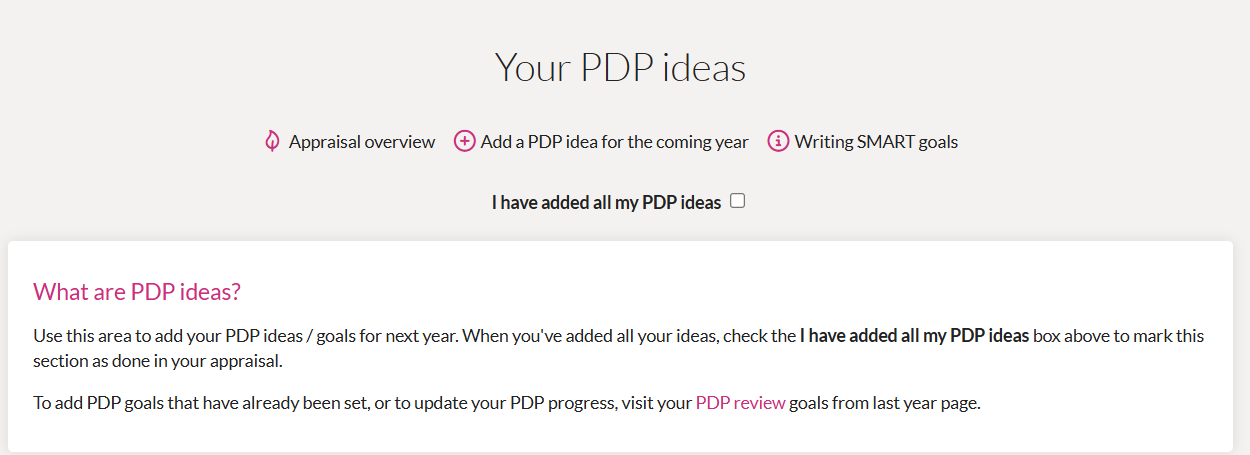
2. On the PDP ideas page, select Add a PDP idea for the coming year.
3. Complete the learning or development need, planned actions, target date and how you will demonstrate success.
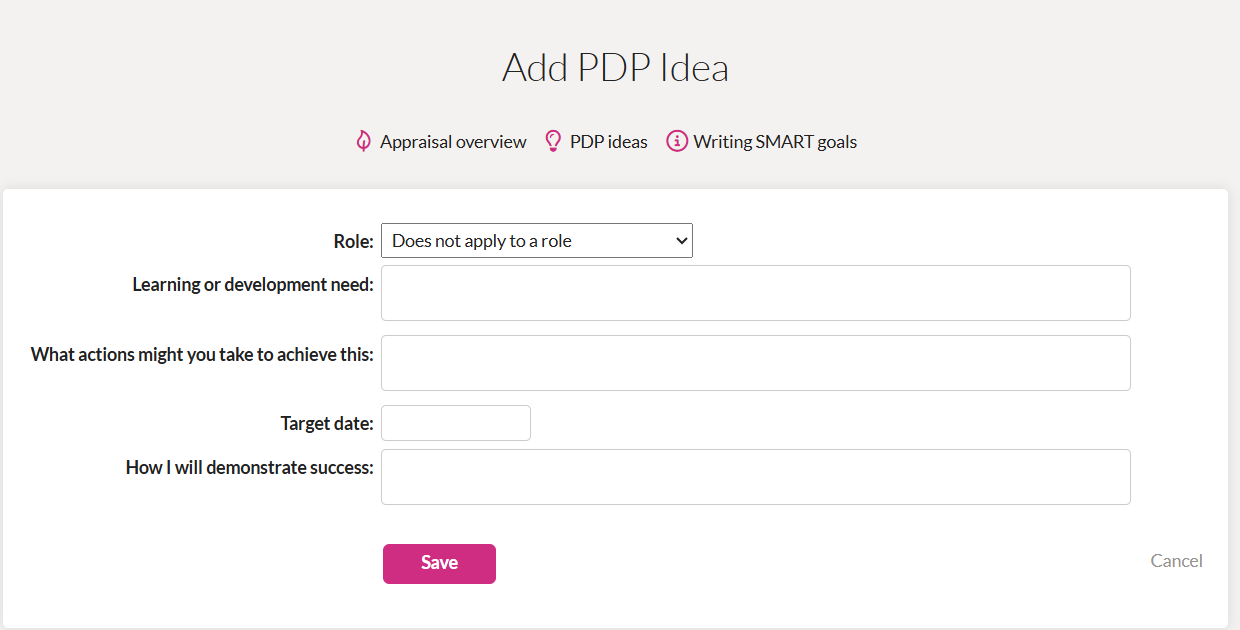
Click Save when finished.
Sources / Last Reviewed
Sources: GMC – Guidance for doctors: requirements for revalidation and supporting information guidance. NHS England / Academy of Medical Royal Colleges – Medical Appraisal Guide 2022 and PDP resources.
Last reviewed: August 2026