Quick Answer
The Quality Improvement (QI) section is where you show that you have looked critically at some aspect of your work, identified whether it could be improved, and reflected on what happened as a result.
Why This Matters
This is an essential section of the appraisal.
Importantly, this is a quality improvement activity section — not necessarily a formal quality improvement project.
You can absolutely include a full audit or QI project, but there are lots of other activities that can also count.
The GMC requirement is that you actively participate in relevant quality improvement activity at least once during each revalidation cycle. So, at least once in the five-year cycle, this section should contain a more formal piece of work such as an audit or quality improvement project.
What Does the Guidance Actually Require?
The GMC requires doctors to actively take part in quality improvement activity relevant to their scope of practice at least once during each revalidation cycle. It does not say that you must complete an audit every year.
In practice, however, the usual appraisal expectation is that you can show some form of quality improvement activity each year. This does not need to be a large formal project — it could be an audit, case review, prescribing review, teaching evaluation or another relevant QI exercise.
What Counts as Quality Improvement?
A large proportion of doctors use 2–3 case-based discussions as their quality improvement activity, usually written up on a structured proforma and discussed with a consultant or senior colleague.
| Type of QI activity | Example |
|---|---|
| Audit | Reviewing current practice against an agreed standard, guideline or target. |
| Re-audit | Repeating an audit after changes have been introduced to see whether practice has improved. |
| Quality Improvement Project | Identifying a problem within a service, introducing changes and measuring whether those changes improve care or efficiency. |
| Teaching and Feedback | Delivering teaching, gathering feedback and using this to improve future teaching sessions or educational programmes. |
| Reflection / Case Review | Reviewing a case, group of cases or an aspect of your own practice to identify learning and changes you could make. |
| Guideline Compliance | Reviewing your clinical practice against local, NICE, Royal College or other recognised guidance and identifying areas for improvement. |
How to Do Quality Improvement Properly
CHOOSE A TOPIC
Pick something relevant to your work
REVIEW IT
Audit, case review, prescribing review,
documentation review, service issue etc
DISCUSS / ANALYSE
What did you find?
What went well?
What could be better?
IDENTIFY LEARNING
What did you learn from the exercise?
MAKE OR CONSIDER A CHANGE
Change practice, improve a process,
or confirm current practice is appropriate
REFLECT
Write up what you did, what you learned
and what happened as a result
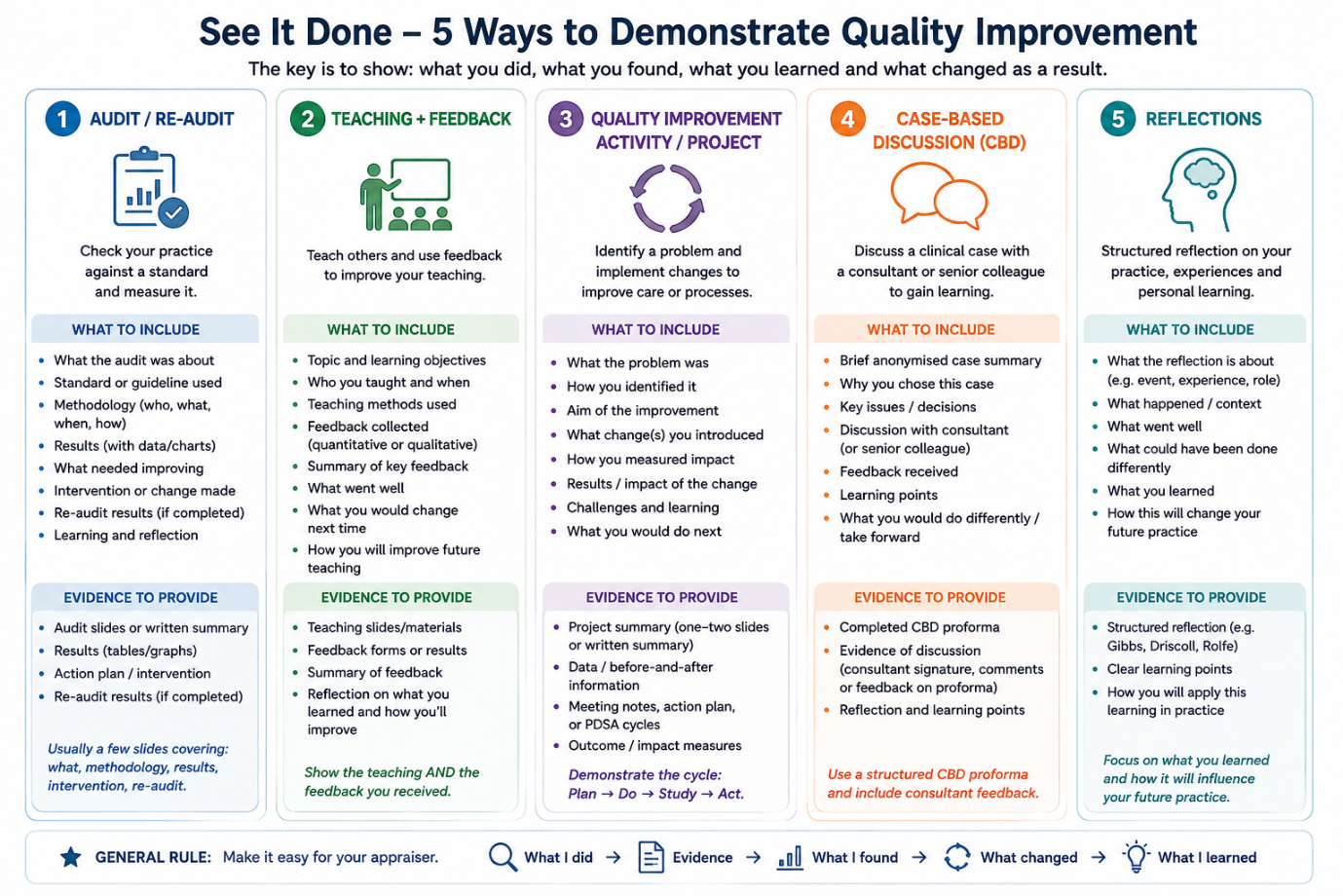
See It Done
What Good Looks Like
A strong quality improvement entry should make it easy for your appraiser to understand what you did, why you did it, what you found and what you learned from it.
Good evidence usually means:
the activity is relevant to your actual scope of practice
your own involvement is clear
there is something tangible to evidence what you did
the results, feedback or learning are clearly described
you explain what changed or what you would do differently
there is some reflection on how the activity has influenced your practice
It does not need to be a huge project. A well-documented audit, teaching activity with feedback, quality improvement project, case-based discussion or structured reflection can all provide useful evidence when written up properly.
Bottom line: make it easy for your appraiser to see the journey — what you did → what you found → what you learned → what changed.
Common Mistakes
The most common mistake is simply writing “I was involved in an audit” in one or two sentences. On its own, this is fairly weak evidence and tells your appraiser very little about what you actually did or learned.
A much stronger entry explains:
what the audit was looking at
the standard or guideline used
the methodology
the results
your own involvement
any intervention or change made
what you learned or reflected on.
Where possible, include supporting evidence such as a short presentation, audit summary, results table or action plan.
If your involvement in an audit was minimal, it is often better to present a different activity that demonstrates your own learning more clearly. Case-based discussions are particularly useful if you are close to your appraisal and need to strengthen this section quickly — 3–4 properly structured CBDs can often be completed at relatively short notice, provided they are written up on a proforma and genuinely discussed with a consultant or senior colleague. This is usually much stronger evidence than simply mentioning an audit you barely contributed to.
I would even prefer to see well-chosen clinical cases taken from journals, educational resources or reputable online sources, written up on a structured proforma and then properly discussed during the appraisal, rather than a vague sentence saying you were involved in an audit. For example, as a geriatrician I can discuss relevant geriatric medicine cases with an appraisee and explore their clinical reasoning and learning. This is not as strong as a CBD based on a real case from your own practice and discussed in context with a senior colleague, but it can still provide useful evidence of learning and reflection.
Myth Trap
“Quality improvement means I need to complete a full audit every year.”
No.
The GMC requirement is to actively participate in quality improvement activity relevant to your scope of practice during the revalidation cycle. A formal audit or QI project is one way of doing this, but it is not the only option.
Other useful evidence can include case-based discussions, structured case review, teaching with feedback, prescribing review or reflective review of practice, provided your own involvement and learning are clear.
Bottom line: the aim is not to manufacture an audit for the sake of appraisal. It is to show that you have reviewed your practice, learned something from it and considered what should change or be maintained.
Sources / Last Reviewed
GMC — Quality Improvement Activity Sets out the requirement to participate in QI relevant to your scope of practice and explains the range of activities that may be appropriate.
GMC — Guidance on Supporting Information for Revalidation Explains how quality improvement fits within the wider supporting information discussed at appraisal.
NHS England — Medical Appraisal Guide Provides practical guidance on presenting and discussing quality improvement activity during appraisal.
Last reviewed: August 2026